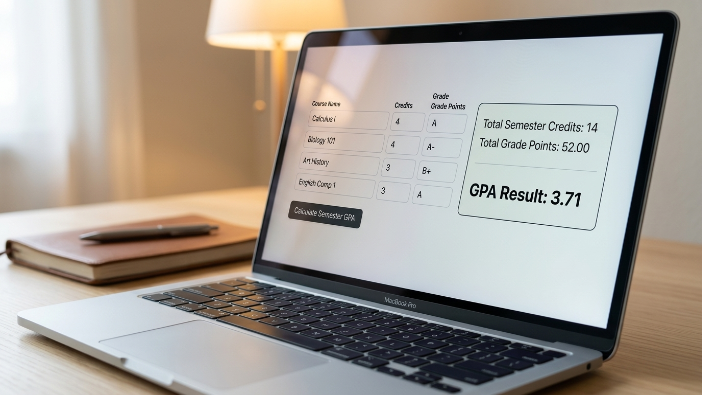

CGPA is one of the most important numbers in a student’s academic life. Whether you are in school, college, or university, your Cumulative Grade Point Average affects admissions, job applications, and scholarships. Yet many students do not fully understand how it is calculated.
In this article, we will explain what CGPA is, how it is calculated step by step, and provide clear examples so you can easily find your own CGPA.
What Is CGPA?
CGPA stands for Cumulative Grade Point Average.
It is the overall average of grade points a student earns across all subjects and semesters throughout their academic program. Unlike a single semester’s GPA, CGPA reflects your entire academic performance from start to finish.
Most universities and schools in India use either a 10-point CGPA scale or a 4.0 GPA scale, depending on the institution.
- GPA (Grade Point Average): Average for a single semester or term
- CGPA (Cumulative GPA): Overall average across all semesters combined
Why Does CGPA Matter?
Before jumping into the formula, it helps to understand why your CGPA is so important.
- Campus Placements: Most companies set a minimum CGPA cutoff (usually 6.0 to 7.5) for eligibility
- Higher Studies: Universities in the US, UK, and Canada require CGPA for MS and MBA admissions
- Scholarships: Many scholarship programs have CGPA requirements
- Government Jobs: Some PSU and government roles ask for a minimum CGPA
A good CGPA opens more doors. A low CGPA can limit your options, though it is not the end of the road.
The CGPA Formula
The basic formula for CGPA is straightforward:
CGPA = Sum of all Grade Points earned ÷ Total number of subjects
For credit-based systems (which most colleges use), the formula becomes:
CGPA = Sum of (Grade Point × Credit Hours for each subject) ÷ Total Credit Hours
This weighted formula ensures that subjects with more credit hours have a greater impact on your overall CGPA.
How to Calculate CGPA Step-by-Step
Step 1 — Find Your Grade Points for Each Subject
Every grade you receive corresponds to a grade point. Here is a standard 10-point grading scale used by many Indian universities:
| Marks (%) | Grade | Grade Points |
|---|---|---|
| 90 – 100 | O (Outstanding) | 10 |
| 80 – 89 | A+ | 9 |
| 70 – 79 | A | 8 |
| 60 – 69 | B+ | 7 |
| 50 – 59 | B | 6 |
| 45 – 49 | C | 5 |
| 40 – 44 | D | 4 |
| Below 40 | F (Fail) | 0 |
Step 2 — Note the Credit Hours for Each Subject
Each subject is assigned a certain number of credit hours based on its importance and teaching hours. For example, a core engineering subject may carry 4 credits, while an elective carries 2 credits.
Step 3 — Multiply Grade Points by Credit Hours
For each subject, multiply its grade point by its credit hours. This gives you the weighted grade points.
Step 4 — Add All Weighted Grade Points
Add up all the weighted grade points you calculated in Step 3.
Step 5 — Divide by Total Credit Hours
Divide the total weighted grade points by the total number of credit hours across all subjects.
The result is your CGPA.
CGPA Calculation Example
Let us walk through a real example with 5 subjects from one semester.
| Subject | Marks | Grade | Grade Points | Credit Hours | Weighted Points |
|---|---|---|---|---|---|
| Mathematics | 85 | A+ | 9 | 4 | 36 |
| Physics | 72 | A | 8 | 3 | 24 |
| Chemistry | 65 | B+ | 7 | 3 | 21 |
| English | 90 | O | 10 | 2 | 20 |
| Programming | 78 | A | 8 | 4 | 32 |
| Total | — | — | — | 16 | 133 |
CGPA = 133 ÷ 16 = 8.31
This student’s CGPA for the semester is 8.31 out of 10.
How to Calculate CGPA for Multiple Semesters
If you want to calculate your overall CGPA across all semesters, you use the same weighted formula — just include all subjects from all semesters together.
Example:
| Semester | SGPA | Credit Hours |
|---|---|---|
| Semester 1 | 8.2 | 20 |
| Semester 2 | 7.8 | 22 |
| Semester 3 | 8.5 | 21 |
| Semester 4 | 8.0 | 23 |
CGPA = (8.2×20 + 7.8×22 + 8.5×21 + 8.0×23) ÷ (20+22+21+23)
CGPA = (164 + 171.6 + 178.5 + 184) ÷ 86
CGPA = 698.1 ÷ 86 = 8.12
Overall CGPA = 8.12
How to Convert CGPA to Percentage
Most college admission forms and job applications ask for a percentage, not a CGPA. Here are the most common conversion formulas:
CBSE (Class 10):
Percentage = CGPA × 9.5
Example: 8.4 CGPA × 9.5 = 79.8%
Most Indian Universities:
Percentage = CGPA × 10
Example: 7.5 CGPA × 10 = 75%
Anna University (Tamil Nadu):
Percentage = (CGPA – 0.5) × 10
Always check your university’s official conversion formula, as it may differ.
CGPA vs GPA — What Is the Difference?
Many students confuse CGPA and GPA. Here is a simple breakdown:
| Feature | GPA | CGPA |
|---|---|---|
| Full Form | Grade Point Average | Cumulative Grade Point Average |
| Period Covered | Single semester | All semesters combined |
| Purpose | Track one semester’s performance | Track overall academic performance |
| Updated | Every semester | Grows with each semester |
Think of GPA as your semester report card and CGPA as your overall academic scorecard.
What Is a Good CGPA?
This is one of the most common questions students ask. The answer depends on your goals:
- 7.0 and above — Good for most campus placements
- 7.5 and above — Required for top MNCs and PSU companies
- 8.0 and above — Competitive for IIT/NIT M.Tech (via GATE)
- 8.5 and above — Strong profile for MS admissions in the US, UK, Canada
Even if your CGPA is below 7, strong projects, internships, and skills can compensate in many careers.
Tips to Maintain or Improve Your CGPA
- Focus on high-credit subjects first — They impact your CGPA the most
- Never miss internal exams — Internal marks are easier to score than end-semester exams
- Study consistently — Last-minute cramming rarely gives the grades that regular study does
- Take advantage of supplementary exams — If you perform poorly, some universities allow grade improvement attempts
- Use a CGPA calculator regularly — Tracking your CGPA each semester helps you spot problems early
Final Thoughts
Calculating your CGPA does not have to be confusing. Once you understand the formula and have your grade points and credit hours in front of you, the math is straightforward.
To summarize:
- Find the grade point for each subject
- Multiply each grade point by its credit hours
- Add all weighted grade points together
- Divide by total credit hours
That gives you your CGPA.
Whether you are tracking your academic progress, preparing for job applications, or planning for higher studies, knowing your exact CGPA puts you in control of your academic journey.
If you want to save time, you can also use a free online CGPA calculator to get instant results without doing the math manually.